
Pilates vs. Walking After 40: Do You Need Both?
If you’re trying to get healthier after 40, you may be wondering whether you should focus on walking or Pilates.
Walking is simple, familiar, and easy to start.
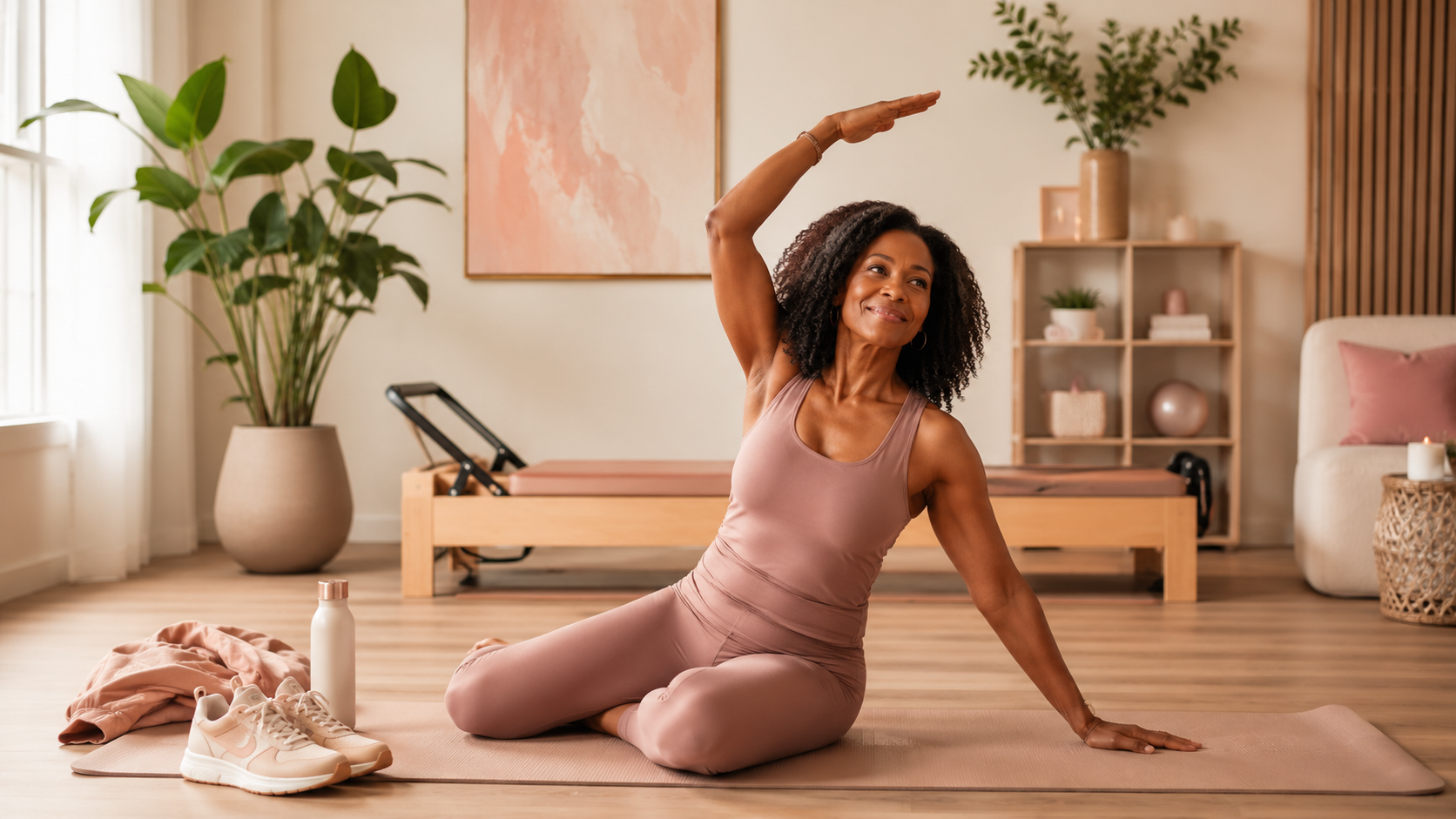
Pilates can help you build strength, improve balance, increase mobility, and become more aware of how your body moves.
So which one is better?
For many women over 40, the answer is not choosing one over the other.
It is using both.
Walking and Pilates can complement each other in a way that creates a realistic, balanced fitness routine without requiring you to spend hours exercising every day.
What Does Walking Do for You?
Walking is one of the easiest ways to become more active.
You do not need special equipment.
You do not need a gym.
And you do not need to know complicated exercises.
You can simply put on comfortable shoes and go.
Walking can help you increase your overall activity level and can be an approachable form of cardiovascular movement for many people.
It is also easy to adjust.
You can walk:
10 minutes
20 minutes
30 minutes
Outside
On a treadmill
Around your neighborhood
At a park
During a lunch break
That flexibility makes walking easier to fit into everyday life.
What Does Pilates Do for You?
Pilates focuses more on strength, stability, mobility, balance, and controlled movement.
It can help you become more aware of things like:
Your posture
Your breathing
Your core
Your balance
Your alignment
How you move through exercises
Walking and Pilates work your body differently.
Walking gives you regular movement and cardiovascular activity.
Pilates gives you more focused strength and movement training.
That is why combining them can work so well.
Is Walking Enough After 40?
Walking is valuable, but it may not address every part of fitness on its own.
As we get older, strength becomes increasingly important.
Many women focus heavily on cardio because that is what they have always been told to do.
But your routine should also include ways to challenge your muscles.
Pilates can help fill that gap.
Instead of thinking:
Walking or Pilates?
Try thinking:
Walking and Pilates.
Can Pilates Replace Walking?
Pilates does not need to replace walking.
They serve different purposes.
You may use walking for:
Daily movement
Light cardio
Stress relief
Getting outside
Increasing activity
And Pilates for:
Core strength
Balance
Mobility
Stability
Controlled strength work
Body awareness
They can work together instead of competing with each other.
Which Is Better for Beginners?
Both can be beginner-friendly.
Walking may feel easier because you already know how to do it.
Pilates may require more instruction at first because the exercises and terminology may be new.
That does not mean Pilates is too difficult.
It simply means there is a learning process.
If you are new to Pilates, private instruction can make that process easier because you can ask questions, slow down, and learn at your own pace.
What If You Haven’t Exercised in Years?
Start small.
You do not need to begin with five workouts per week.
You may start with something as simple as:
Monday: 15-minute walk
Wednesday: Pilates
Friday: 15-minute walk
That is enough to begin building a routine.
Once that feels manageable, you can add another Pilates session or another walk.
You do not need to rush.
A Simple Walking and Pilates Schedule for Beginners
Here is a realistic weekly plan:
Monday: 20-minute walk
Tuesday: Pilates
Wednesday: Rest
Thursday: 20-minute walk
Friday: Pilates
Saturday: Easy walk or light activity
Sunday: Rest
This gives you:
Regular movement
Strength-focused exercise
Recovery days
A routine that does not take over your life
That balance can be especially helpful for women over 40 who are trying to become more active without burning out.
How Long Should You Walk?
Your walks do not need to be long when you are starting.
Try:
Week 1: 10–15 minutes
Week 2: 15–20 minutes
Week 3: 20–25 minutes
Week 4: 25–30 minutes
You can gradually increase your time as walking becomes easier.
There is no need to turn every walk into a race.
The goal is to move consistently.
How Often Should You Do Pilates?
For beginners, one to two Pilates sessions per week can be a practical starting point.
As you become more comfortable, you may choose to increase to two or three sessions per week.
You do not need to do Pilates every day.
Consistency matters more than doing as much as possible.
Which Is Better for Weight Loss After 40?
Neither walking nor Pilates should be treated as a magic weight-loss solution.
Weight management involves more than exercise.
Your overall habits matter, including:
Nutrition
Sleep
Stress
Daily movement
Strength training
Consistency
Walking can help increase your daily activity.
Pilates can support strength and muscle engagement.
Together, they can be part of a realistic wellness routine.
But if weight loss is one of your goals, it is important to look at the whole picture instead of relying on one type of workout.
Which Is Better for Building Strength?
Pilates is generally the stronger choice if your main goal is focused strength, especially core strength and controlled bodyweight work.
Walking is movement, but it does not challenge your muscles in the same way a structured Pilates workout can.
That is one reason I encourage women not to rely only on walking.
Walking is excellent.
But strength matters too.
Which Is Better for Balance and Mobility?
Pilates has the advantage here as well.
Many Pilates exercises challenge:
Balance
Core stability
Coordination
Mobility
Controlled movement
That can be especially helpful as you get older.
You are not just exercising for today.
You are building habits that can help you stay active and capable over time.
Which Is Easier to Stay Consistent With?
That depends on your life.
Walking is easy because you can do it almost anywhere.
Virtual Pilates can also be convenient because you can do it at home without driving to a studio.
For many women, the best routine is one that removes unnecessary barriers.
If you can walk in your neighborhood and do Pilates at home, you have two forms of movement that can fit into a busy schedule.
What If You Only Have 20 Minutes?
Use the 20 minutes.
You do not need a perfect hour-long workout.
You could do:
10-minute walk + 10 minutes of Pilates
or
20-minute Pilates session
or
20-minute walk
Any of those options is better than deciding 20 minutes is not enough and doing nothing.
Pilates and Walking After 40 Can Work Better Together
You do not have to choose.
Walking can help you move more.
Pilates can help you move better and become stronger.
Together, they can create a simple, balanced routine that feels much more sustainable than extreme workout plans.
And sustainability matters.
A routine you can repeat every week is far more useful than one you can only maintain for ten days.
Ready to Add Pilates to Your Routine?
If you already enjoy walking but want to add more strength, balance, and mobility work, virtual private Pilates can be a great next step.
My virtual private Pilates sessions are designed to help beginners learn Pilates from home with personalized guidance and support.
We can start at your current fitness level and build gradually.
No crowded class.
No pressure to keep up.
No need to already know what you are doing.
Book your virtual private Pilates session with Mocha Pilates Studio and start building a balanced routine that works for your life.